
Production
Prototype the Question, Not the Whole Game
A practical method for turning an uncertain design idea into a small, answerable prototype before production begins.
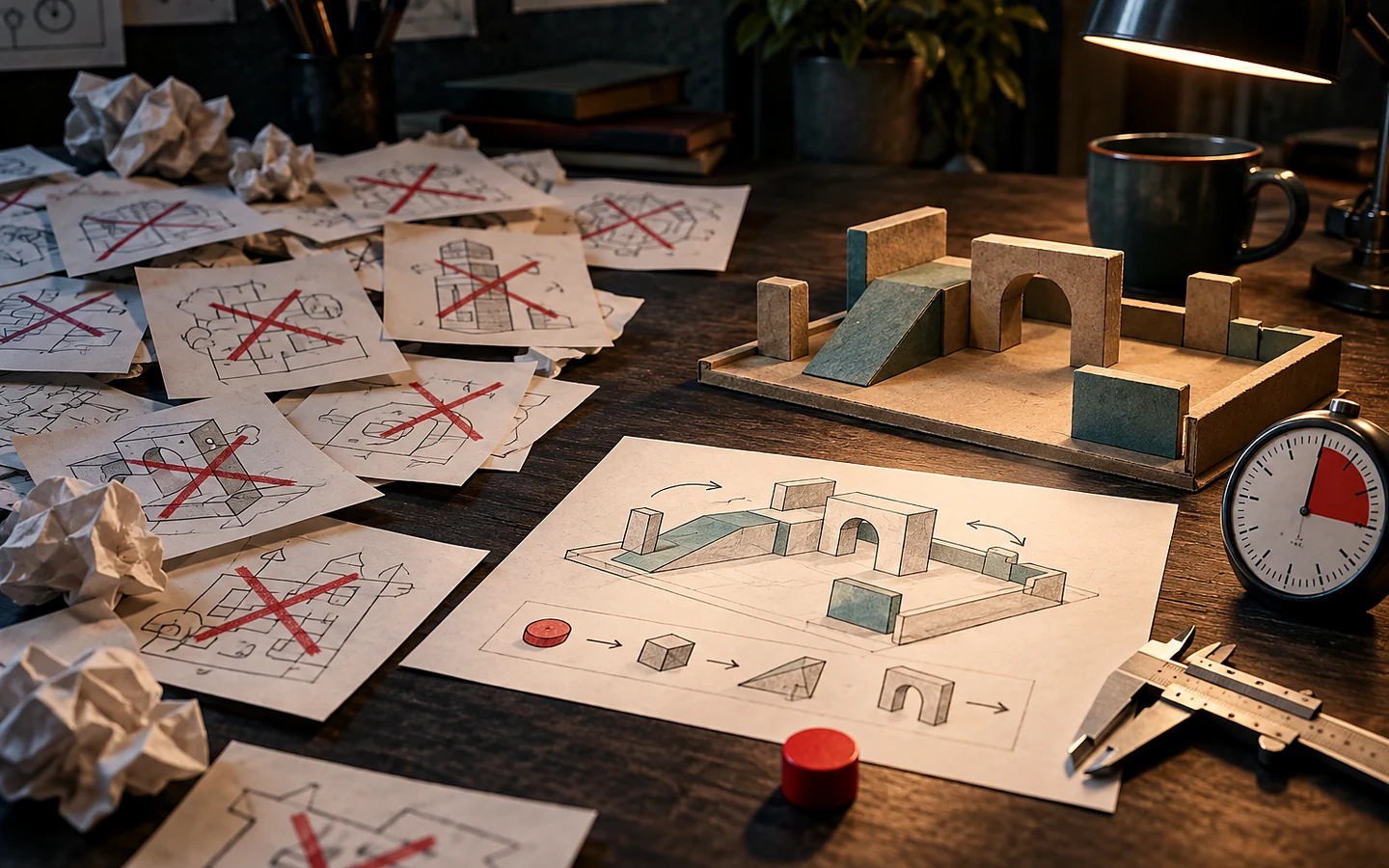
A useful prototype does not prove that a game is finished. It reduces one important uncertainty. The most efficient question is usually specific: can players read the movement arc, does a choice create an interesting trade-off, or can the camera support the intended speed? When a prototype tries to answer all of those questions at once, every result becomes ambiguous.
Write the decision before opening the engine
Begin with a decision the team will make after the test. “We are prototyping combat” is too broad. “We need to choose between a short committed dodge and a long steerable dodge” is answerable. Record the two options, the player behaviour that would support each option, and the result that would make the team stop pursuing both. This keeps the build from turning into an unplanned vertical slice.
The question should identify an audience and context. A precision platformer played with a controller has a different readability problem from a touch game used in short sessions. State the assumed device, input method, session length, and player familiarity. These constraints are not production promises; they are the boundary of the experiment.
Build the smallest observable loop
A minimum prototype contains the action, feedback, and consequence needed to observe the decision. For a jump, that may mean one character capsule, three blockout platforms, a restart key, and a visible landing state. It probably does not require final art, an inventory, dialogue, progression, or a complete menu. Grey boxes are valuable because they prevent visual polish from disguising weak timing or unclear rules.
Keep variables exposed. Movement speed, acceleration, grace time, camera lag, damage, cooldown, and spawn intervals should be easy to change without rebuilding unrelated systems. A short variable sheet turns subjective reactions into a record: build A used a 0.18-second input buffer; build B used 0.10 seconds. The numbers do not decide the design, but they make comparison possible.
A worked example: testing a risk-and-reward jump
Imagine a small platform game with a normal route and a dangerous shortcut. The question is whether the shortcut feels tempting rather than arbitrary. Build one room with both routes. Give the shortcut a visible reward and make failure restart the room immediately. Ask five testers to play without explanation, then observe route choice, hesitation, failures, and whether the reward was noticed.
If nobody sees the shortcut, changing jump physics will not answer the question; the problem is signposting. If everyone sees it but refuses it, compare the perceived reward with the cost of failure. If players repeatedly attempt it and describe failure as fair, the basic trade-off may be worth developing. This example shows why the decision must precede the build: the same room can expose three different problems.
Separate observation from interpretation
Write what happened before explaining why. “Three players walked past the ledge” is an observation. “The ledge is too subtle” is an interpretation. A later review may reveal that the camera hid it, the reward lacked contrast, or players were still learning the primary route. Keeping the two columns separate reduces the urge to redesign around the loudest comment.
Ask neutral follow-up questions. “What were you looking at here?” is more useful than “Did you miss the shortcut?” Avoid teaching the mechanic during the first attempt unless the test is specifically about instruction. A prototype that only works after its designer explains it has uncovered an onboarding requirement, not passed the test.
Define the exit before polishing
A prototype needs a stop condition. End it when the question is answered, when the evidence says the direction is not promising, or when the next uncertainty requires a different build. Archive the build, variable sheet, clips or notes, conclusion, and unresolved risks. Do not quietly promote experimental code into production because it happens to exist.
Our editorial judgment is simple: the best prototype is often disposable. Its lasting output is a clearer decision and a traceable record. Teams with limited time gain more from several narrow experiments than from one attractive demo that leaves the central design risk untouched.
Sources and verification
Primary documentation checked on 25 September 2026. Product and platform requirements can change; recheck the linked source before release work.