
Player Experience
Design Failure Feedback Players Can Act On
Show what happened, why it mattered, and what the player can try next without turning every miss into a tutorial.
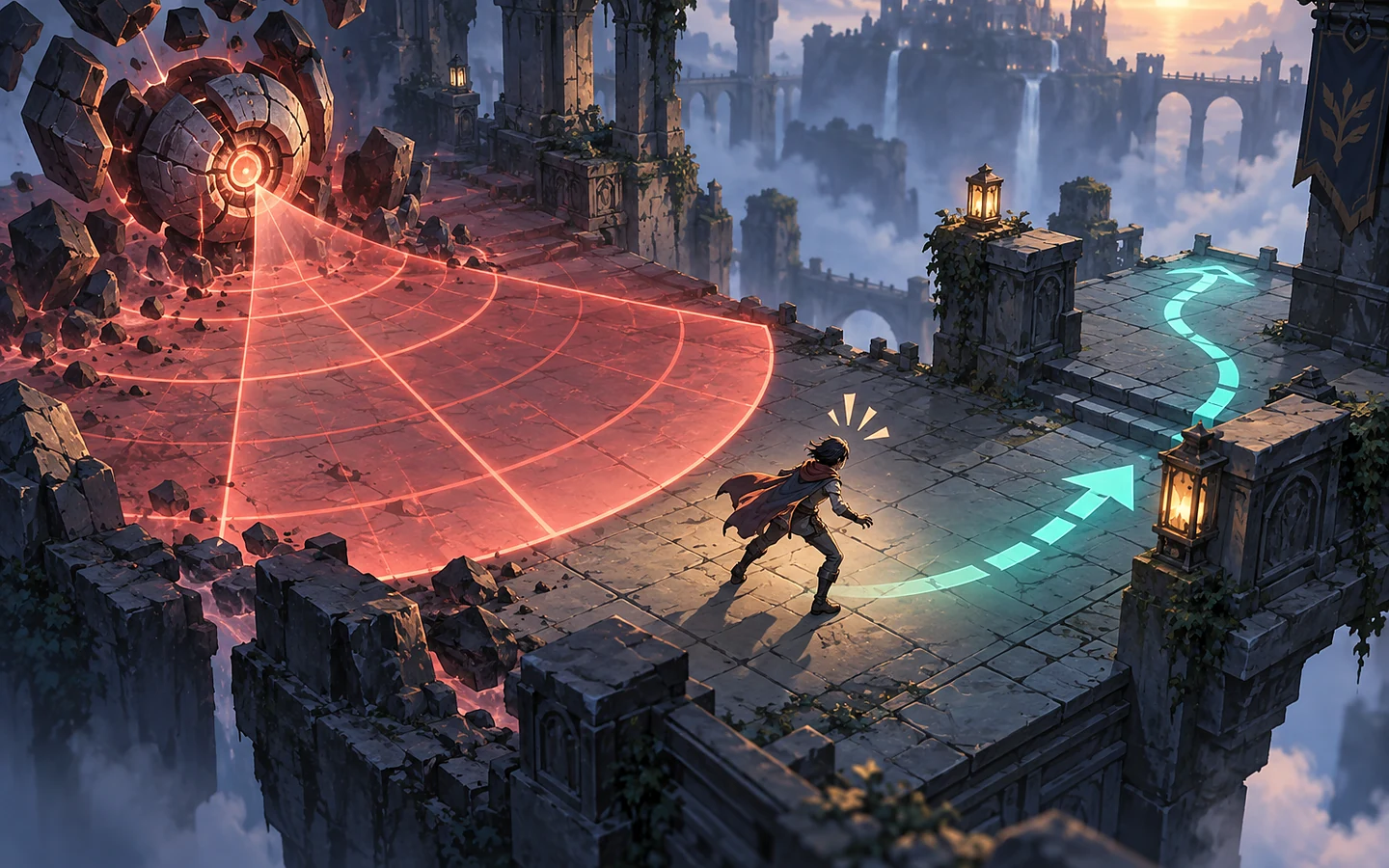
Failure becomes productive when the player can connect an outcome to a rule and choose a new action. A dramatic effect that only says “wrong” may look polished while leaving the next attempt unchanged. Clear feedback combines timing, location, cause, consequence, and recovery in proportions suited to the game.
Identify the information the player needs
After a failure, ask whether the player can answer four questions: what state changed, what caused it, which prior signal predicted it, and what options remain. Not every game should reveal hidden calculations, but the player needs enough evidence to form a better hypothesis. Mystery is different from unreadability.
Use multiple channels for essential events. A damage cue may combine animation, sound, controller response, a directional indicator, and a health change. Players should be able to reduce or disable motion and vibration without losing the only warning. Colour should reinforce rather than carry the complete message.
Match feedback to the timescale
Immediate execution failures need fast, local feedback: the attack was blocked, the jump input arrived late, or the target was out of range. Strategic failures may need a later summary that connects resource choices over several minutes. Trying to explain a long-term economy problem with a red flash at the final moment is too late.
Preserve a short cause history when several events overlap. Damage logs, recap cards, or replay markers can help players understand a rapid sequence. Keep the detail optional so it does not interrupt players who already understand the system.
A worked example: the unseen hazard
During a test, players repeatedly lose health while crossing a misty room. The hazard uses a low hum and a slight green tint, but ambient audio masks the hum and some displays flatten the colour difference. Players conclude that damage is random.
A revision adds a distinct ground pattern before the active area, a readable edge, a character reaction, and an optional directional damage marker. The first entry remains surprising, but the second attempt becomes informed. If players still cannot predict the boundary, the team adjusts spatial presentation rather than increasing the punishment.
Protect the player’s next attempt
Restart time is part of feedback. A clear lesson loses value when the player waits through a long reload, repeated dialogue, or an unskippable animation. Place checkpoints before the decision being tested, restore the relevant state consistently, and avoid changing unrelated variables between attempts.
Offer contextual help after a repeated pattern rather than after every single miss. Help should name the relevant rule and remain dismissible. Difficulty adjustments are strongest when they preserve the intended decision—slower timing, clearer anticipation, or additional resources—rather than silently completing the action.
Validate with behaviour
Ask players to explain what they think happened, then watch whether their next action changes. Correct explanation without improved action may indicate an execution barrier. Improved action without correct explanation may still be acceptable for a learn-by-doing system, but the team should know which kind of learning it created.
Our recommendation is to judge failure feedback by the quality of the next attempt. If players repeat the same action because the game supplied no usable evidence, the difficulty is informational rather than mechanical. Fixing that distinction can make a game feel fair without making it easy.
Sources and verification
Primary documentation checked on 25 September 2026. Product and platform requirements can change; recheck the linked source before release work.